Quick answer: Low CTR means your page appears in search but few people click. Compare your CTR with the typical range for your position, then improve the title tag, meta description and rich results on pages with high impressions. Change one thing at a time and compare 28 days before and after.
A low CTR with high impressions is one of the fastest SEO wins available. You do not need new rankings or new content. Your page is already visible, so the job is to make the listing more appealing than the ones around it. This guide shows how to find low CTR pages, how to judge what a good CTR is and how to raise it safely.
Low CTR vs zero clicks
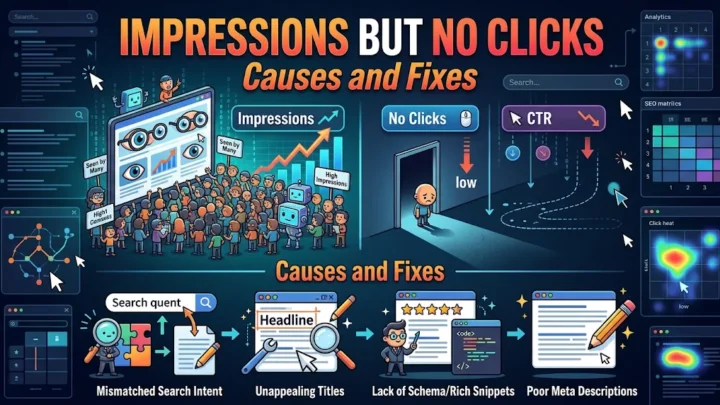
Zero clicks means nobody chooses your result. Low CTR means some people do, but far fewer than your position deserves. If you see no clicks at all, start with our guide on impressions but no clicks. If you get some clicks but fewer than expected, you are in the right place.
CTR stands for click-through rate: clicks divided by impressions, shown as a percentage. Google defines it in the Performance report documentation.
What is a good CTR?
CTR depends on industry, device, query type and the features on the results page. The ranges below are rough averages for non-branded queries. Use them to spot outliers, not as targets.
| Position | Typical CTR range |
|---|---|
| 1 | about 25 to 30 percent |
| 2 | about 12 to 16 percent |
| 3 | about 8 to 11 percent |
| 4 to 10 | about 1 to 6 percent |
If a page ranks in the top 3 and gets a CTR below 5 percent, there is likely room to improve.
How to find low CTR pages
- Open Search Console, then Performance, then Search results.
- Turn on Total clicks, Total impressions, Average CTR and Average position.
- Click the Pages tab and sort by impressions.
- Add a position filter for pages ranking in the top 10.
- List pages whose CTR is clearly below the range for their position.
- Exclude branded queries, which have naturally high CTR and can hide real problems.
8 proven ways to fix low CTR
1. Make the title specific. Numbers, years and benefits help. Example: “7 Ways to Fix Indexing Issues (2026 Guide)” beats “Indexing Help”. Google explains how it builds title links.
2. Match the exact query wording. If people search “how to fix”, do not title the page “Resolution Strategies”.
3. Keep titles visible. Titles over about 60 characters can be cut off. Put the main keyword first.
4. Use curiosity carefully. Words like proven, simple, checklist and mistakes can help, but never promise what the page does not deliver.
5. Write a strong meta description. Lead with the benefit and end with a call to action. Google may rewrite it, but a clear description raises the chance your text is used. Read Google’s snippet guidelines.
6. Add eligible rich results. Ratings, breadcrumbs and product data make a result larger and more trustworthy. See the structured data gallery.
7. Use a clean URL. A short readable URL such as servigate.com/fix-indexing-issues looks more credible than a long string of parameters.
8. Win the featured snippet. A direct 40 to 60 word answer near the top of the page can earn a snippet, which usually lifts CTR.
Example: a before and after title
Before: “SEO Tips – Servigate”. After: “7 SEO Tips for Small Business Websites (2026)”. The second title includes a number, a clear audience and the year, so it tells the searcher exactly what they will get.
A/B testing without special tools
- Record the page, the old title, the date and the last 28 days of CTR.
- Change only the title or only the description.
- Wait 3 to 4 weeks.
- Compare CTR for the same queries and similar impressions.
- Keep the winner and note the result in a spreadsheet.
Why CTR may stay low even after fixes
If AI summaries, maps, videos or shopping results sit above your listing, even a perfect snippet will lose clicks. In that case, improve ranking too. Our guide on moving from page 2 to page 1 covers position improvements.
Checklist before you edit a title
- Confirm the page ranks in the top 10 for the query you want to improve.
- Check what the top 3 competitors promise in their titles and descriptions.
- Decide on one clear benefit and put it in the first 40 characters.
- Make sure the page really delivers the promise, so visitors do not bounce back to Google.
- Write down the old title and the date of the change.
How rich results and brand strength affect click-through rate
Searchers click familiar names more often. If your brand is unknown, a specific, trustworthy title matters even more. Star ratings, breadcrumbs and clear page names can increase trust at a glance. Over time, building brand searches, through helpful content and consistent mentions, also lifts CTR because people recognize and prefer your result.
Common mistakes that keep CTR weak
- Using the same title pattern on every page, so listings look identical.
- Stuffing several keywords into the title instead of writing for humans.
- Ignoring mobile, where titles and descriptions are truncated sooner.
- Judging a change after one week instead of at least 28 days.
- Forgetting that a rise in impressions can lower CTR even when clicks grow. Watch clicks as well as the percentage.
Tracking your improvements
Create a simple sheet with these columns: URL, query, position, old CTR, change made, date and new CTR. Review it monthly. Over a few months you will see which kinds of titles work best for your audience, and you can apply the pattern to new pages from the start.
Frequently asked questions
What is a good CTR in Google Search Console?
For non-branded queries, about 25 to 30 percent at position 1, 12 to 16 percent at position 2 and 8 to 11 percent at position 3. Lower positions earn progressively less.
How do I improve CTR without changing rankings?
Rewrite the title tag and meta description, add numbers or the current year, match the exact query wording and add eligible structured data such as ratings or breadcrumbs.
How long should I wait after changing a title?
Wait 3 to 4 weeks, then compare CTR with the previous 28 days for the same page and queries.
Does Google always use my meta description?
No. Google may rewrite it to match the query, but a clear, relevant description still raises the chance your text is used.
Conclusion
Low CTR is an opportunity, not a penalty. Find pages with high impressions and weak CTR, improve their titles and snippets one at a time, and measure over 28 days. This is usually the quickest way to get more traffic from rankings you already have.