Quick answer: Impressions but no clicks means searchers see your result and choose another one. The usual causes are a ranking position below 10, a weak title tag, a missing or unappealing meta description, SERP features that answer the query and a mismatch with search intent. Fix the snippet first, then work on ranking.
Seeing impressions but no clicks in Google Search Console feels discouraging, but it is actually useful information. Google already considers your page relevant enough to show. What is missing is a reason for the searcher to choose you. Zero clicks in Search Console is usually a snippet problem, a position problem or an intent problem, and all three can be fixed.
What impressions but no clicks tells you
An impression means your page appeared in the results. A click means someone chose it. When you get impressions without clicks, the hard work of being shown has partly succeeded, and the remaining work is persuasion and position. Google’s guide to the Performance report explains how impressions, clicks, CTR and position are calculated.
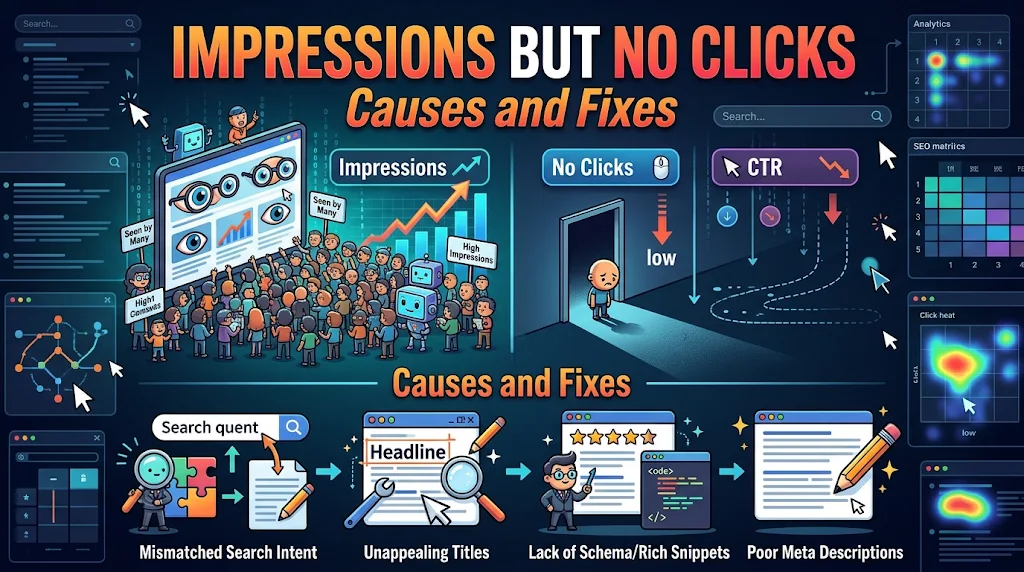
6 reasons you get impressions but no clicks
1. Your position is too low. Results at positions 8 to 20 are seen by fewer people, and many searchers never scroll that far. Most clicks go to the top few results.
2. Your title tag is weak. A vague title like “Home” or “Services – Servigate” gives people no reason to click. Google explains how it creates title links and why clear, descriptive titles matter.
3. Your meta description is missing or poor. Google may pull random text from the page. A good description acts like an advertisement. See Google’s advice on snippets.
4. SERP features take the click. Featured snippets, People Also Ask boxes, maps, videos and AI-generated answers can satisfy the question without a visit.
5. Your page does not match search intent. If you rank for a keyword that your page does not truly answer, searchers see the title, sense the mismatch and skip it.
6. The queries are irrelevant. Some impressions come from accidental queries far from your topic. These will never convert, so do not chase them.
Rough CTR by position
Click-through rates vary by industry, device and SERP layout. The ranges below are rough industry averages for non-branded queries, so treat them as a guide, not a rule.
| Position | Typical CTR range |
|---|---|
| 1 | about 25 to 30 percent |
| 2 | about 12 to 16 percent |
| 3 | about 8 to 11 percent |
| 4 to 10 | about 1 to 6 percent |
| 11 and below | usually under 1 percent |
If your position is under 10 and you still get zero clicks, test the snippet. If your position is above 10, ranking comes first.
How to fix zero clicks step by step
- Find the pages. In Search Console open Performance, then Pages, sort by impressions and look for pages with zero or near-zero clicks.
- Find the queries. Click a page, open Queries and note the top 5 queries that trigger impressions. Remove irrelevant ones from your thinking.
- Rewrite the title. Include the exact query, a benefit and a hook. Example: change “Plumbing Services” to “Emergency Plumber in Islamabad: Arrives in 60 Minutes”.
- Write a persuasive meta description of 140 to 155 characters with a clear benefit and call to action.
- Add structured data where eligible. Review, Product, Service and Breadcrumb schema can make results richer. Note that FAQ rich results are now limited to government and health sites. Browse Google’s structured data gallery to see what applies to you.
- Aim for the featured snippet. Add a direct 40 to 60 word answer near the top of the page, followed by detail.
- Improve ranking with better content, internal links and a few relevant backlinks if your position is worse than 10. Our guide on moving from page 2 to page 1 explains how.
Mistakes that keep clicks at zero
- Changing five things at once, so you cannot tell what worked.
- Writing clickbait that the page does not deliver. This raises clicks briefly, then hurts engagement.
- Ignoring branded queries mixed into your data.
- Judging results after 3 days instead of 3 to 4 weeks.
How to measure the result
Change one page at a time and note the date. After 28 days compare clicks, impressions, CTR and position against the previous 28 days. If you want a deeper walkthrough of benchmarking, read our article on low CTR despite high impressions.
Real-world examples (illustrative)
Example 1: a local service page. Imagine a page for an emergency plumber that ranks at position 7 for a high-value query. The title tag says only “Home”. Searchers see a bland result next to competitors that mention response time and location. Rewriting the title with the service, the city and a clear benefit usually gives people a reason to choose the listing.
Example 2: a blog post beaten by a featured snippet. A how-to article ranks at position 3, but a featured snippet above it answers the question fully. Here the fix is to win the snippet yourself by placing a short, direct answer at the top of your page and using a clear heading that repeats the question.
Example 3: a page that misses intent. A page about “SEO tools” ranks for “SEO services” and gets impressions but no visits, because searchers want to hire someone, not compare software. Either change the page to match the intent or create a separate page that does.
A simple 30 day action plan
- Week 1: export your top 20 pages by impressions and mark those with fewer than 10 clicks.
- Week 2: rewrite titles and descriptions for the 5 pages with the highest impressions and the best match to your business.
- Week 3: add a direct answer, a short FAQ and internal links to those 5 pages.
- Week 4: compare clicks, CTR and position against the previous 28 days, keep what worked and repeat for the next 5 pages.
Frequently asked questions
Why do I get impressions but no clicks?
Usually because your result ranks too low, your title and description are unappealing, or Google shows a featured snippet or AI answer that satisfies the user. Review position and snippet first.
Do impressions without clicks hurt my SEO?
No. They are not a penalty. They show Google considers the page relevant, so improving the snippet and ranking can turn them into clicks.
How many clicks should I expect at position 5?
Roughly 3 to 6 percent of impressions for non-branded queries, though this varies by industry and SERP features.
Should I ignore irrelevant queries in Search Console?
Yes. Focus on queries that match the page topic and intent, since irrelevant queries will rarely produce clicks.
Conclusion
This is a fixable problem. Start with your title and description, check that your page truly matches intent, then work on position. Small snippet changes on the right pages can turn invisible impressions into real visitors within a month.